
Most packaging failures don’t start with sealing, design, or logistics.
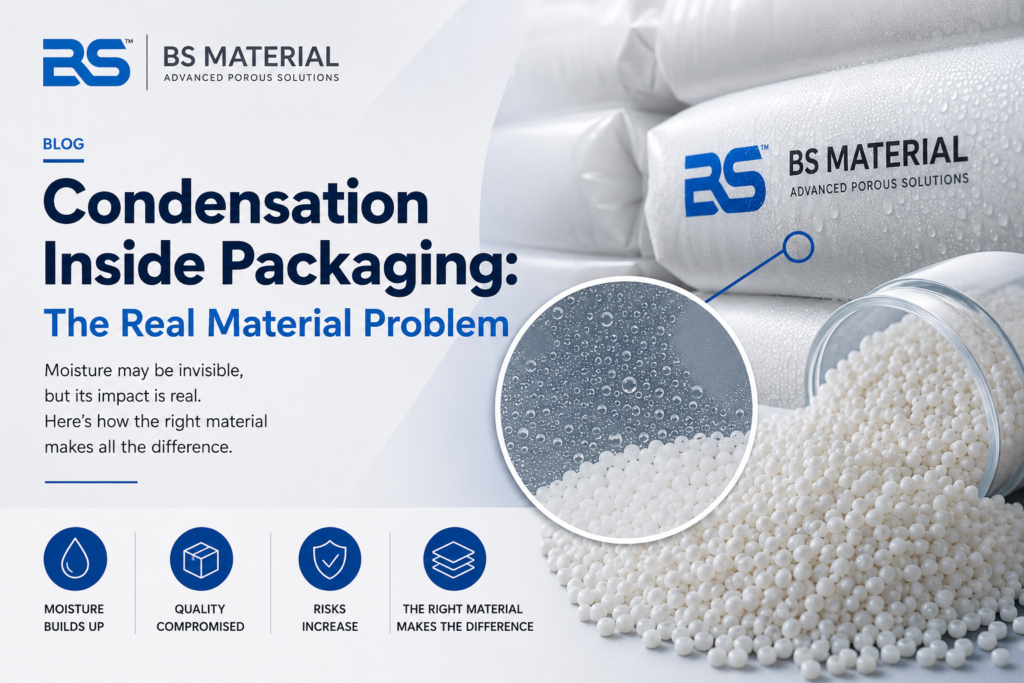
They start with something much less visible — condensation.
You’ve probably seen it before:
- Moisture droplets forming inside sealed packaging
- Fogging that ruins product visibility
- Unexpected spoilage or shortened shelf life
And the instinctive reaction is usually:
“We need better barrier packaging.”
But that’s often the wrong direction.
Condensation isn’t a sealing problem — it’s a material mismatch
Condensation happens when:
- Warm air inside the package cools down
- Moisture reaches saturation
- Water has nowhere to go
So it turns into droplets.
Simple physics. But here’s the key:
If your packaging completely blocks moisture, you’re trapping the problem inside.
The common mistake: Over-engineering barrier layers
In many cases, packaging structures are designed like this:
- PET / PE laminates
- OPP + CPP
- Multi-layer barrier films
They perform well in:
✔ Oxygen barrier
✔ External moisture protection
But fail when:
❌ Internal moisture needs to escape
This is where condensation builds up.
What actually solves it: Controlled breathability
Instead of asking
“how do we block moisture?”
The better question is:
“how do we manage moisture?”
This is where microporous breathable films come in.
They work differently:
- Allow water vapor to pass through
- Block liquid water penetration
- Maintain structural integrity
In other words:
✔ Moisture can escape
✔ Product stays protected
Why breathable HDPE structures work
Breathable films based on HDPE microporous structures create:
- A network of micro-channels
- Selective permeability (vapor vs liquid)
- Stable performance under temperature changes
This makes them especially effective in:
- Medical packaging with sterilization needs
- Food packaging with respiration
- Industrial products sensitive to condensation
It’s not about “more barrier” — it’s about the right balance
This is where many sourcing decisions go wrong.
More layers ≠ better performance
What matters is:
- MVTR (Moisture Vapor Transmission Rate)
- Application environment (temperature shifts)
- Product moisture behavior
The goal is not to eliminate moisture
The goal is to control where it goes
A practical shift in thinking
Instead of asking suppliers:
❌ “Do you have high-barrier films?”
Try asking:
✔ “What MVTR range fits this product?”
✔ “How does this structure handle internal condensation?”
✔ “Can this material breathe without compromising protection?”
That’s where real solutions start.
What we focus on in real applications
At the material level, solving condensation is never about a single feature.
It’s about getting the balance right.
In our work with breathable HDPE structures, we focus on:
- Controlled breathability, not overexposure
Designed MVTR ranges that allow vapor to escape without compromising protection - Stable performance across temperature shifts
Maintaining consistency in real-world conditions, not just lab testing - Compatibility with different converting processes
Supporting lamination, printing, and downstream applications without performance loss - Application-driven structure design
Not one standard film, but structures adjusted based on product behavior and environment
Final thought
Condensation inside packaging is not a defect.
It’s a signal.
A signal that the material is working against the product, not with it.
And once you start designing for moisture balance instead of moisture resistance,
the entire packaging logic changes.