
[vc_row][vc_column][vc_column_text css=\”\”]
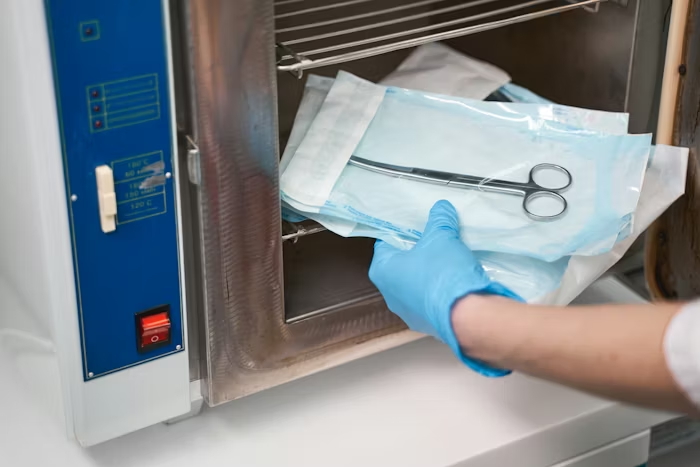
For surgical teams and clinical directors, the integrity of the sterile field is non-negotiable. While Ethylene Oxide (EO) sterilization remains the gold standard for heat- and moisture-sensitive medical instruments, the packaging surrounding these tools is frequently the weakest link. When a pouch fails—whether through micro-punctures, compromised seals, or particulate shedding during opening—patient safety is immediately put at risk.
The Hidden Risks of Conventional Packaging
Many surgical facilities have long relied on legacy spunbond polyolefin materials for their sterilization rolls and pouches. While historically standard, these conventional fibrous materials present documented clinical challenges:
-
Particulate Shedding (The \”Snow Effect\”): When peeling open traditional porous webs, microscopic fibers can tear and fall directly into the sterile field. This introduces foreign particulates that can increase the risk of surgical site infections (SSIs) or trigger foreign-body reactions.
-
Puncture Vulnerabilities: Orthopedic tools, trocars, and sharp retractors require packaging with immense tensile strength. Conventional materials can suffer invisible micro-tears during transport or handling, silently compromising the sterile barrier.
-
Inconsistent Aeration: EO gas must penetrate the packaging and, just as importantly, fully aerate out. Inconsistent material porosity can trap residual EO, posing toxicological risks to both the surgical staff and the patient.
Why Medical-Grade HDPE is Advancing Sterilization Protocols
To address these specific clinical pain points, medical packaging engineers are increasingly turning to advanced High-Density Polyethylene (HDPE) as the superior alternative for EO sterilization packaging rolls.
Here is how medical-grade HDPE directly translates to improved clinical outcomes:
-
100% Clean Peel Technology: Unlike fibrous alternatives, advanced HDPE films are engineered for a smooth, cohesive peel. This \”clean stripping\” ensures that absolutely no particulates or paper dust are introduced into the operating theater when presenting the instrument to the surgeon.
-
Exceptional Puncture and Tear Resistance: HDPE provides a highly durable, resilient matrix that withstands the sharpest surgical instruments. It maintains its structural integrity from the autoclave to the storage room, ensuring the instrument remains sterile until the exact moment of use.
-
Optimized Microbial Barrier & Gas Permeability: HDPE is scientifically calibrated to allow the precise molecular flow required for EO gas penetration and rapid off-gassing, while simultaneously establishing an impenetrable barrier to super bacteria and pathogens. It consistently meets stringent ISO 11607 and EN 868 standards.
-
Moisture and Fluid Defense: In dynamic clinical environments, accidental exposure to fluids is a reality. HDPE boasts superior fluid resistance compared to legacy porous materials, safeguarding internal sterility against external liquid breaches.
Securing the Supply Chain at the Source
For healthcare facilities, migrating to high-performance packaging is only half the equation; the other half is securing a reliable, direct factory source to ensure consistent material quality and compliance. Sourcing directly from the manufacturer eliminates the risk of compromised or sub-clinical grade materials entering the hospital supply chain.
This is where specialized material science comes into play. If your facility is looking to upgrade its sterilization protocols with fiber-free, puncture-resistant packaging, exploring dedicated HDPE solutions is the next logical step. At Banshan Material, we engineer advanced HDPE packaging specifically designed to meet the rigorous demands of modern clinical environments. To learn more about how our materials can secure your sterile field, visit us at bs-material.com.
[/vc_column_text][/vc_column][/vc_row][vc_row][vc_column][vc_toggle title=\”How does medical-grade HDPE quantify the reduction of “Fiber Shedding“ in the sterile field?\” css=\”\”]Conventional spunbond polyolefin or paper-based packaging often suffers from microscopic delamination during the peeling process, commonly referred to as the \”snow effect.\” These foreign particulates, if introduced into a surgical site, can trigger granulomatous reactions or increase the risk of Surgical Site Infections (SSIs). Banshan Material engineers its HDPE sterilization rolls with a high-cohesion molecular structure that ensures a 100% fiber-free peel, physically eliminating packaging-derived contaminants from the sterile field.[/vc_toggle][vc_toggle title=\”Regarding sharp orthopedic or interventional instruments, how does HDPE balance puncture resistance with gas permeability?\” css=\”\”]This is a challenge of polymer density. Banshan optimizes the molecular weight distribution of its HDPE to provide a high-modulus barrier that significantly exceeds the puncture resistance of standard fibrous webs. Simultaneously, the material is calibrated for precise Ethylene Oxide (EO) gas diffusion and rapid aeration, ensuring total sterilization of complex instrument geometries while maintaining a 100% reliable microbial barrier during post-sterilization transit.[/vc_toggle][vc_toggle title=\”Why is HDPE integrity critical for the Central Sterile Supply Department (CSSD) workflow?\” css=\”\”]The primary pain point for surgical teams is \”compromised sterility\” discovered mid-procedure. Conventional materials are susceptible to micro-tears and moisture-induced barrier failure during storage. Banshan Material’s HDPE is hydrophobic and chemically inert, maintaining its structural integrity even in fluctuating humidity or high-friction transport environments. This minimizes the need for costly re-sterilization cycles and ensures that the instrument remains \”theatre-ready\” from the moment it leaves the autoclave.[/vc_toggle][vc_toggle title=\”Is HDPE compatible with both Ethylene Oxide (EO) and Vaporized Hydrogen Peroxide (VHP/Plasma) modalities?\” css=\”\”]Clinical facilities often utilize dual sterilization paths based on instrument sensitivity. Banshan medical-grade HDPE is non-polar and thermally stable, making it fully compatible with both EO and VHP (Plasma) processes. Unlike certain cellulose-based materials that can degrade or inhibit Plasma cycles, our HDPE ensures consistent material performance and microbial barrier validation across multiple sterilization platforms.[/vc_toggle][/vc_column][/vc_row]